
Twenty-Seven Miniatures: In Prague, the Loss Is the Most Honest Document
**मुख्य उत्तर (≤60 शब्द):** ChessBase Magazine के 225वें अंक में प्राग शतरंज महोत्सव 2025 का कवरेज है, जिसमें अरविंद चिदंबरम, अनिश गिरि, एदिज़ गुरेल और डेविड नवारा अपने खेलों का स्वयं विश्लेषण करते हैं। अंक का 'स्पेशल' सेक्शन सत्ताईस मिनिएचर खेलों पर केंद्रित है — पच्चीस चालों से पहले समाप्त होने वाले खेल, जो ओपनिंग तैयारी में छेद को सबसे साफ़ दर्ज करते हैं। **मुख्य तथ्य:** - अंक में 27 मिनिएचर शामिल हैं, जो मुख्य रूप से प्राग शतरंज महोत्सव 2025 से लिए गए हैं। - यान वर्ले, डैनियल किंग
In the first-floor hall of Prague's Hotel Don Giovanni, in the last week of February 2026, a scoresheet stopped at move twenty. There were thirty-eight minutes left on the clock. A chair pushed back, a hand extended, and a grandmaster walked out of the room the way a writer puts down the pen mid-sentence and leaves the desk. I was watching the live transmission from Pune at four in the morning. What the screen showed was not a defeat. It was an open door, and behind that door stood the question I have been asking for more than thirty years: chess remembers the wins, while the most informative document in the game is the loss.
ChessBase Magazine's 225th issue carries a section simply called 'Special' — twenty-seven miniatures, games that ended before move twenty-five, and the magazine calls them highly entertaining. That adjective is doing quiet work. It took me straight back to the notebook I have kept for years, the one I fill with negative spaces: draws, silences, empty chairs, and the games that finished too quickly. Twenty-seven miniatures are not an entertainment package. They are a diagnostic report, and to read it you have to stop looking at the board and start looking inside the preparation room.
The festival, the hotel, and a closed room
Prague's international chess festival sits in the same hotel where it was born. Its architecture differs from every other big event on the calendar: a ten-player round-robin Masters on one side, a Challengers on the other, and beneath them a vast Open where hundreds of club players sit in the same building as Anish Giri and David Navara. No stadium, no commentary booth, no flashbulbs. One hall, ten boards, and rain outside.
I have always trusted this format more than the theatrical ones. In the room with no board, the small windows still held a tournament — that was the feeling I chased while scripting the 2026 Online Olympiad, and it returns in a closed round robin like Prague. Ten players. Everyone knows everyone three months out. No strangers, no surprises. Preparation matters as much as calculation, which is why, when something breaks, it breaks in the preparation and not in the arithmetic.
Issue 225 is the full ledger of that festival. Aravindh Chithambaram, Anish Giri, Ediz Gurel and David Navara annotate their own games. Jan Werle, Daniel King and Robert Ris contribute opening videos. Ten opening articles offer new repertoire ideas, alongside the tactics, strategy and endgame training sections. Delivery comes two ways: a direct download with the booklet as a PDF, or a printed booklet by post with a download key. The issue also opens as a ChessBase Book for iPad, tablet and Mac.
That list reads dry. Look closer and the business model is visible: what is being sold is not the game but the analysis. And the analysis can only be written by the person who took the loss. That is the real finding inside this product, and it is the thing our clip-and-highlight era keeps walking past.
What twenty-seven miniatures actually testify to
A miniature is conventionally a game finished inside twenty-five moves. The word carries a faint whiff of shame in chess — someone slipped, someone got caught. I do not accept that framing, and twenty-seven is my evidence.
Twenty-seven miniatures in one tournament does not mean twenty-seven fools. It means twenty-seven occasions when a hole in someone's preparation was found by the opponent's database before it was found by the opponent's board. And knowing where the hole sits matters to everyone who plays that line, not only to the man who lost. A twenty-move game explains where a line dies more cleanly than thirty pages of annotation, because nothing in it was rescued.
Twelve draws taught me that silence can be a tactical weapon. A miniature is the other face of that coin — not silence but a sudden speaking out. Just as the twelve draws of London 2026 taught me that the story often lives where nothing happened, the Prague miniatures suggest the story also lives where everything happened too fast.
The most revealing tactic is the pause before the next move. A miniature removes the pause. That is why these games are frightening: they never show you the instant a player realised it was over. They begin at the result.
The engine paradox: the deeper the preparation, the more brittle it becomes
Here is the inversion I have felt forming over the last eight or ten years. Engines and databases made preparation deeper and, at the same time, made it shared. When the world's top ten players all pass through the same engine, the same cloud database and the same three analysts, their preparation stops being distinct. It becomes branches of one tunnel.
So when the contest breaks, it breaks precisely where both players remembered the same answer and neither had verified it. Losing on move twenty does not mean a player cannot think. It means he trusted an engine's recommendation, and the engine took no responsibility for it.
That is why I read the twenty-seven as a collective document rather than a set of personal embarrassments. They mark the places where shared knowledge outran individual understanding and weakened itself in the process. In a preparation arms race the fastest runner often falls first, because he is on the road everyone built together.
I have seen the same pattern on the Indian domestic circuit, where two players from one academy play the same line and fall into the same trap because one coach handed them one file. In Prague it happens at global scale, only with more expensive coaching.
The honesty economy: men who explain their own defeats
This is where the magazine separates itself from the broadcast. A broadcast shows you the win. A magazine gives you the man talking about his loss. Aravindh, Giri, Gurel and Navara each open their own game and point at the damage.
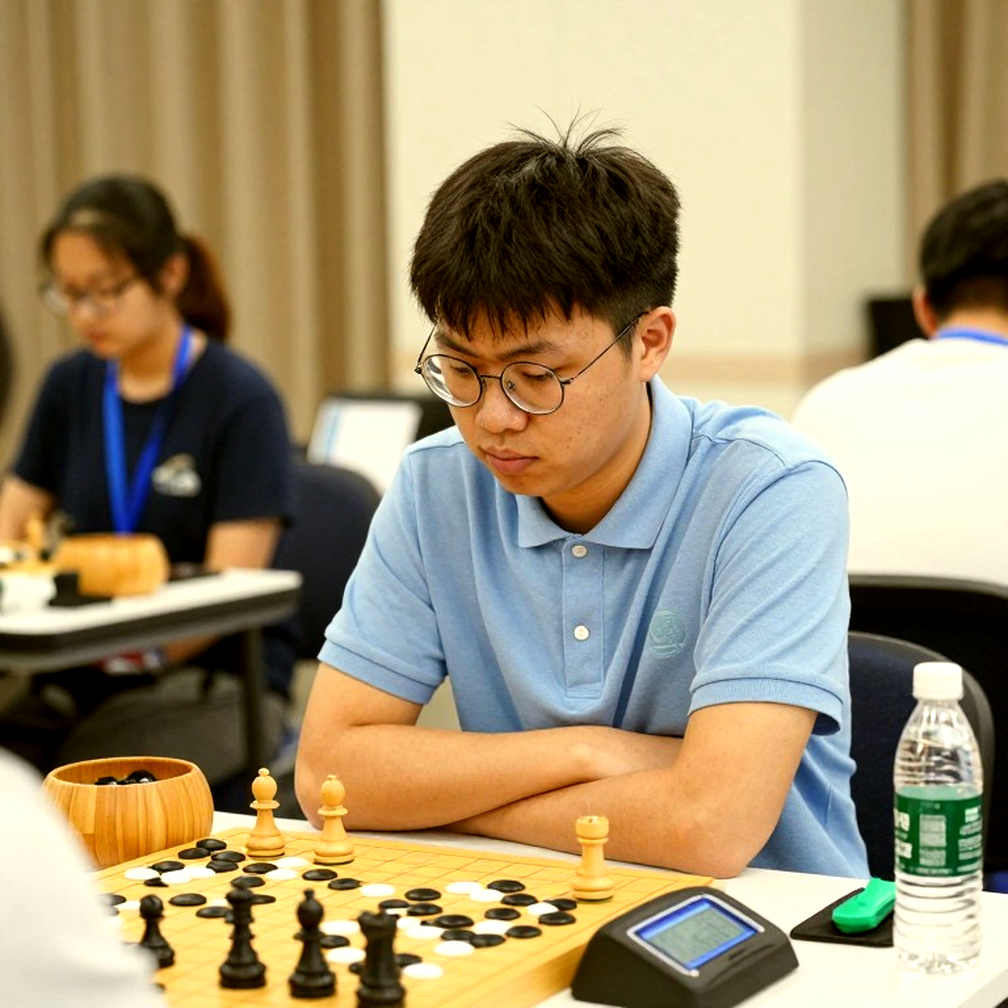
Giri's name sits in the most interesting slot on that list. He spent a long stretch of his career mastering the draw — and I mean that as praise. The man who can draw twelve times is also the man who can tell you where a draw begins. His analysis is often faster in language than on the board, and that is his advantage: he does not give you a list of moves, he gives you a sequence of decisions.
Navara is different because he is playing in his own city. The weight of Czech chess has rested on him for a decade, and he carries it without complaint — playing, annotating, guiding juniors. In Prague he is the pillar nobody notices until it moves. When he opens his own defeat on the page, he is not explaining a game. He is teaching a generation that a loss should be taught, not hidden.
And then Gurel. A teenager whose entire childhood was scheduled around boards, now annotating in the same magazine I first picked up in the 1990s. That is the moment you feel how quickly chess's knowledge system is changing hands.
Navara and the Czech machinery
I do not know Czech chess intimately, but I know this: for its population, the country produces grandmasters at one of the highest rates in Europe. The reason is unglamorous. Clubs. The Extraliga team from a town like Novy Bor, chess hours in local schools, and a tradition in which the senior player sits down with the junior. This is the machinery I look for every time a teenager flashes and the media presents him as weather. Prague's festival survives because it sits inside that machinery. It was not built by a patron's cheque. It was built on a tradition that already existed. Watch a tournament for ten years and you stop thinking about its sponsor and start thinking about its organisers' stubbornness.
Aravindh and the pipeline we call a miracle
Aravindh Chithambaram is the heaviest part of this issue for me, and the reason is geographic rather than political. He is from Chennai. Chennai means the Velammal school, the Tal Chess Club lineage, Tamil Nadu's cash award schedule, and the AICF election cycle that every chess player knows and almost nobody writes about.
His career is not a straight line. As a junior he belonged to the group people called 'next', then he stood in roughly the same place for nearly a decade — strong, respected, always one step behind the headlines. Then, in his mid-twenties, he came back, and now he is playing the events from which magazine annotations are made.
I will not call that delay a miracle. I will call it the pipeline's second cycle. Tamil Nadu's system raises thirty children at once; some emerge early, some late. The late ones carry something the early ones often do not — patience, and the habit of staying seated. Aravindh's whole style is built from that habit: he does not strike early, he waits, and then plays the move that forces the other man to do the analysis.
Which is exactly why his game belongs in this issue. A player who trusts position over victory is the one who can explain where preparation breaks, because he is the one still sitting at the board when it does.
Three videos, and the late arrival of pedagogy
Issue 225 carries opening videos by Werle, King and Ris. Three names, one shared quality nobody notices: all three come out of the European coaching tradition, and all three made teaching chess their identity rather than playing it.
Daniel King's name is the heaviest here. From the video-cassette era to streaming, he has done one thing across four decades — turn a position into language. I learned from his Power Play series what no book taught me: that you look at the structure before you look at the move.
My late-arrival observation is that video pedagogy was always present in chess, and its economy always arrived late. Print validated annotation first, then cassette, then streaming. Every time the technology changed, the same three or four people were standing at the front, because the ability to teach comes from patience rather than from a format.
Ris's annotation manner is fast and direct; Werle's more structural. That three-way split is an editorial decision, not an accident — three different learning speeds in one issue, so the 1800 club player and the 2600 grandmaster each find their own pace.
Ten opening articles, and an asset that goes stale
There is an economic truth here that chess rarely states out loud. Only one thing in chess goes stale every season: opening theory. Endgame principle from a century ago still works; tactics never die; strategy holds. But a repertoire that works today can be broken next year by some teenager's engine output.
So the ten opening articles are the most commercial part of the magazine, and the most necessary. It is a subscription you renew every two months because the asset is decaying underneath you. I like the model because it is honest. It does not promise to make you a better player. It only tells you your line is still alive.
The contrarian part
Now the section where I argue with my own profession.
Over the past decade India built the largest media machine chess has ever had. When we started ChessBase India in 2026, we had no idea that a decade later it would pass roughly 2.9 million YouTube subscribers and become the country's biggest chess newsroom. That achievement is real and I am proud of it.
But a gap survived, and it is visible. We built the audience; the annotation culture is still imported. When the twenty-seven miniatures need opening, the people who open them sit in Prague, Amsterdam and Hamburg. A country that gave the world Gukesh, Praggnanandhaa, Vaishali, Humpy and Harika does not yet write the long, serious, technical post-mortem of its own players' defeats in Hindi. We make videos of the wins. We do not file documents of the losses.
That is my contrarian claim: the twenty-seven miniatures are not entertainment, they are diagnosis — and we do not yet have the language to read the diagnosis. We built the noise of cricket without learning the silence of chess. And in chess the real knowledge lives in the silence.
The second inversion concerns Prague's format. When people say chess needs noise, stadiums and franchise seasons to grow, I ask a simpler question: what actually made the players better? A closed hotel room, ten boards, and two weeks. The format in which nothing happens is the format that teaches the most.
What to watch next
Closing the issue, I am left with a question about generations rather than numbers. The largest chess audience of the next decade will be in India; that is settled. The open question is who will explain it. Will players like Aravindh — now in his mid-twenties, having waited a decade for his place — hand that generation the language spoken in the rooms of Prague? Or will we keep importing it every two months, a booklet by post and a download key attached?
The scoresheet that stopped at move twenty in Prague is now inside a magazine, and from there it will reach a club player's tablet. Nobody threw it away in between. That is the quietest, least noticed achievement of this whole industry — that a defeat was preserved so a stranger could read it and not fall ill the next time.
The question is not who the next champion will be. The question is who will write his first loss.