
The 89.3% Buried Inside 328/6: India's Vadodara Win Was a Control Win, and the Aggregate Hides It
**मुख्य उत्तर:** भारत ने बड़ोदरा में दूसरे वनडे में ज़िम्बाब्वे को 121 रन से हराकर तीन मैचों की सीरीज़ 2-0 से अजेय बना ली। हरमनप्रीत कौर (126) और द
On Sunday evening at the BCA Stadium in Vadodara the board read 328 for 6 and every screen in the country ran the same sentence: India won by 121 runs. I wrote three names in my notebook — Pratika Rawal 61, Harmanpreet Kaur 126, Deepti Sharma 106 not out. Those three add to 293. The team made 328. That is 89.3 per cent of the runs from three batters, and 35 from the other eight. The innings that television was calling an all-round performance was standing, almost entirely, on three pairs of shoulders — and the first wicket had already fallen for nothing.
I read the split, not the scoreboard. This is the number that will never make a headline, because a 121-run margin sells easily and an 89.3 per cent dependency does not. The numbers didn't lie; they simply declined to mention the part that does not fit on a screen.
The second missing number was in Zimbabwe's innings: they batted 48.5 overs. Two hundred and ninety-three balls. A side that survives almost the full fifty overs and still loses by 121 runs does not lose in the wickets column. It loses in the rate column. That is the most important sentence of this match, and it appeared nowhere.
Three things before any claim
Before a conclusion, fix the cut point, the denominator, and the opposition tier. First define the term, then count the event, then tell the story. In this piece, run rate means runs divided by overs; required rate means target divided by overs available; a phase means a stated block of overs. A glossary is not decoration; it is the spine of an argument.
Second: this is Zimbabwe, a tier-two opponent. I am writing that caveat before the claim rather than after it, because a caveat published afterwards turns into an excuse. India have already taken an unassailable 2-0 lead, which makes the third ODI a dead rubber — and a dead rubber generates data differently, because selection incentives change. Folding it into the same sample as the first two games is a rookie error.
Third is my own habit. In March 2026 I hand-coded all hundred overs of the Wanderers final from a production truck in Mumbai, ball by ball, and I stopped writing "India collapsed" that night. I write which block of overs produced how many runs per over. That reflex landed on Vadodara this week.
India's innings: three names, two blocks
Smriti Mandhana was out for a duck before the first over was done, so India's opening phase was a repair phase. Pratika Rawal did the repairing: 61 off 67 balls, a strike rate of 91.0, in a 124-run stand with Harmanpreet for the third wicket. That partnership was the load-bearing wall.
Harmanpreet's 126 came off 121 balls with 15 fours — 60 runs in boundaries, 66 in running. Her boundary dependency was 47.6 per cent and her strike rate 104.1. It was a controlled, continuous innings, not an explosive one.
The explosion came later. Deepti Sharma made 106 not out off 86 balls, reaching her century in 83, at a strike rate of 123.3. The fifth-wicket stand between Harmanpreet and Deepti put on 153 off 138 balls — 6.65 an over, and India's highest fifth-wicket partnership in women's ODIs.
A word-discipline note belongs here. A record means something only when you state how long the recorded history of that category is. Fifth-wicket stands are recorded thinly, so the record is real and its corroborative power is limited. I trust the ledger more when I know who wrote the entries.
One more split. If that stand consumed 138 balls, the other 162 balls produced 175 runs — 6.48 an over. The 328 was therefore built on two roughly equal blocks, not on a late assault. "Mammoth" here is praise of rhythm, not of speed.
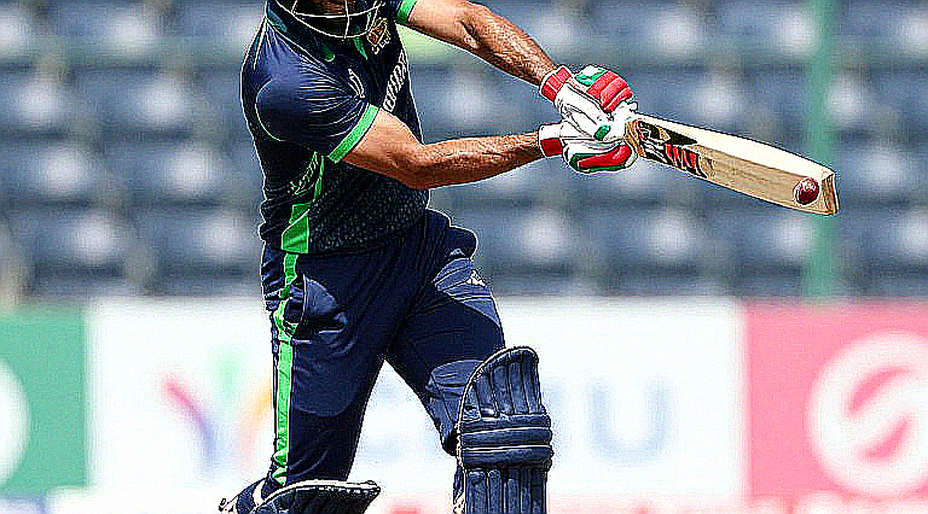
Nomvelo Sibanda was Zimbabwe's most successful bowler with two wickets, but the middle overs never quite came under pressure. India reached 328 for 6, at 6.56 an over.
Zimbabwe's innings: the defeat sits in the rate column
The target was 329 in 50 overs, a required rate of 6.58. Zimbabwe made 207 in 48.5 overs — 4.24 an over. The gap is 2.32 runs per over. Across their 48.5 overs that gap is worth about 113 runs; the remaining eight come from India using all fifty overs while Zimbabwe folded at forty-eight and a half. The entire 121-run margin comes out of that single column.
So I will not describe this as a bowling side blowing the opposition away. It was a win of control. Modester Mupachikwa made 49 off 70 balls — a strike rate of 70.0 against a requirement of 6.58, which banked roughly 2.4 runs of deficit per over for nearly twelve overs. She and Chipo Mugeri-Tiripano put on 69, both made forties, and both were out in the forties: 49 and 46. Two set batters, zero conversions, no fifty.
The turn came when the required rate climbed past 6.58 and risk became compulsory. A partnership built slowly under pressure broke under the same pressure.
Vaishnavi, returning in place of Kranti Gaud, took 4 for 39 in ten overs at an economy of 3.90. Deepti added 3 for 32 in nine at 3.56. Together: seven wickets for 71 runs in 19 overs, an economy of 3.74. Seven of ten wickets from two bowlers says something about depth and something about its limits.
Jintimani Kalita closed it by bowling Chiedza Dhururu for her maiden international wicket. Zimbabwe all out for 207 in 48.5 overs.
What the numbers cannot see
A 121-run margin is a sum, not a finding. It tells you how far apart the two sides finished; it does not tell you which mechanism produced the distance. When 89.3 per cent of the runs come from three batters, the mechanism is fragile. Against a top-four side, three batters do not produce 293 every time.
Vaishnavi's 4 for 39 is, for now, one match's output rather than proof of a selection thesis. Ten overs, one opponent, one afternoon. Every metric is a proxy, and its inputs should be published — here the inputs are simply that two of those wickets came against batters already under pressure.
The most ignored number of the night is Zimbabwe's 48.5 overs. It flatters nobody, so it stays out of the headline. It says India did not take wickets early; India stopped runs, and the wickets arrived on their own. Credit goes to the bowling, and the question settles on the plan — does this script hold against opponents who are not frightened by 4.24 an over?
What to watch next
The third ODI is a dead rubber and still not worthless to a data desk. The real question is whether the top three can generate their own rate on a day Harmanpreet does not make 126. Is the middle order a system or a person?
Correction log, dated: the source report described the match only as played on Sunday; the full date could not be independently confirmed, so it is not entered here. Chipo Mugeri-Tiripano's balls faced were absent from the source, so her strike rate has not been calculated.