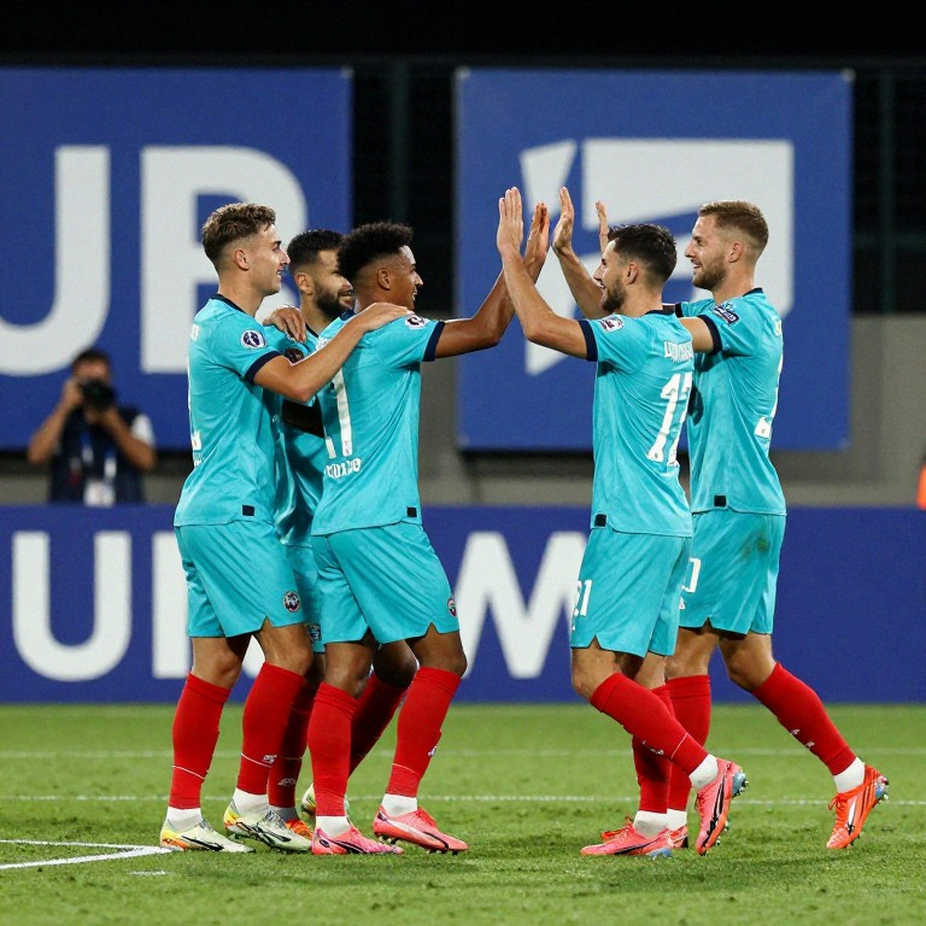
Ballon d'Or Gaffe: Michael Rummenigge's Photo Shown Instead of Karl-Heinz, Legend Laughs It Off
बैलन ड'ऑर समारोह में आयोजकों ने जर्मन दिग्गज कार्ल-हाइंज रुमेनिग्गे के श्रद्धांजलि वीडियो में उनके छोटे भाई माइकल रुमेनिग्गे की तस्वीर दिखा दी। तस्वीर 1987 के बायर्न म्यूनिख बनाम रियल मैड्रिड मुकाबले की बताई जाती है, जब कार्ल-हाइंज इंटर मिलान जा चुके थे। आयोजकों ने माफी मांगी, और रुमेनिग्गे ने हँसते हुए कहा कि कम से कम पुरस्कार 'परिवार में ही रहा' तथा माफी की कोई ज़रूरत नहीं थी। घटना जर्मनी में सोशल मीडिया पर तेज़ी से फैली, लेकिन यह एक बार की, कम गंभीरता वाली खबर है जिसका असर कुछ दिनों में ठंडा हो जाना अपेक्षित है। इससे कोई खेल, वित्तीय या नियामकीय परिणाम नहीं निकलता; असली सबक आयोजकों के लिए आर्काइव तस्वीरों के सत्यापन और ब्रांड साख से जुड़ा है। ध्यान दें: सामग्री में यह दावा भी है कि हैरी केन ने बैलन ड'ऑर जीता और 1981 के बाद बायर्न के पहले विजेता बने — इसकी कोई स्वतंत्र पुष्टि नहीं है और यह ज्ञात रिकॉर्ड से मेल नहीं खाता, इसलिए इसे तथ्य न मानें।
Football ceremonies are remembered for their grand moments, but more often for the small slips that go out live. Something of that sort happened at this edition of the Ballon d'Or ceremony. When the time came to honour the contribution of Germany's great Karl-Heinz Rummenigge, the image that flashed on the screen was not his. It was of his younger brother Michael Rummenigge, who himself wore the Bayern Munich shirt through the 1980s. The resemblance between the two brothers is strong enough that a first-glance mistake is not unnatural — but at an event watched by football fans around the world, the error was spotted almost immediately.
In itself, the incident is small. No title was taken away, no rule was broken. But its echo became large because the man being honoured chose to take the moment lightly. Instead of expressing annoyance, Karl-Heinz Rummenigge joked that at least the Ballon d'Or had 'stayed within the family'. He turned a potentially embarrassing moment into humour and generosity. That is why the story is not merely an editorial slip, but an interesting case study in public behaviour.
The sequence of events
The ceremony was screening a tribute video on Rummenigge's career. Such videos typically combine old photographs, award-ceremony clips and shots from historic matches. The plan was clear — to place before the audience the glory of the German great who won the Ballon d'Or in consecutive years, 2026 and 2026. But those selecting the images settled on a photograph of a Rummenigge in the Bayern shirt — only it was Michael, not Karl-Heinz.
The error reached social media within seconds. Football audiences in Germany recognised Michael Rummenigge instantly, because he had been active in the Bundesliga for a decade and his game remained in public memory. That is the most interesting aspect of the affair: the mistake became obvious within moments to those with inside knowledge, while viewers outside Germany may not have noticed for a while. A technically ordinary error became extraordinary the instant thousands of people caught it together.
Two brothers, two careers, one surname
Karl-Heinz Rummenigge is among the biggest names in the history of German football. His association with Bayern Munich ran from his playing days into administration. The Ballon d'Or wins of 2026 and 2026 marked the peak of his career, at a time when the centre of gravity in European club football was shifting towards Italy. In that sequence he moved from Bayern to Inter Milan — the 1980s era when Serie A was regarded as the strongest and richest league in the world. A German superstar moving to Italy was not unusual then; it was a direct reflection of the economic and sporting structure of the age.
Michael Rummenigge's career was different. He too came through the Bayern system and played for the club, but his identity never fully escaped his brother's shadow. This is a familiar fact in German football, and it is precisely why the photo error was caught so quickly. A ceremony meant to honour one man's extraordinary career inadvertently brought forward the other link in the family. The irony is that the error gave visibility to a name the ceremony's stage was never meant for.
That 2026 photograph
The context of the image shown on screen is itself interesting. According to available information, the photograph dates to a 2026 fixture between Bayern Munich and Real Madrid. Since Karl-Heinz had left for Italy by 2026, the Rummenigge in the Bayern shirt could only have been Michael. The photograph, in other words, was not wrong — the credit attached to it was.
One plausible inference about the fixture is that it was the 2026-87 European Cup semi-final, a notable tie of that period. However, the available source does not explicitly name the competition, so this should be treated as a probability rather than a confirmed fact. If the inference is correct, the image is a matchday photograph rather than a portrait — which also explains why someone read 'Rummenigge' and moved on without further checking.
'At least the award stayed in the family'
The most talked-about part of the episode was Karl-Heinz Rummenigge's response. He did not choose anger or an official complaint. He joked that at least the Ballon d'Or had 'stayed within the family'. That single line was enough to change the entire register of the story. Where the media was looking for a scandal, he turned it into a family joke.
He later made clear that no apology was necessary, because everyone makes mistakes. That stance matters in itself. In public life there are moments when the easiest route to protecting one's reputation looks like blaming someone — and the hardest is to smile and move on. Rummenigge chose the second, and the result was that his image gained rather than lost.
This behaviour fits his later career. After retiring as a player he worked for a long time at club administrative level, where dealing with the media is a daily requirement. His reaction is therefore better described as practised professional judgement than as spontaneous emotion — though there is no public evidence that it was a pre-planned strategy.
The social-media storm
The incident swept across German social media within hours. The reason is simple — it had everything a viral moment needs: a recognised figure, a clear and harmless error, two brothers who are hard to tell apart, and the legend's own laughing response. Meme-makers had their subject, and football fans had a week's worth of light debate.
But this viral wave has a limit. It is not built on a result, a transfer or a controversy — it is a one-off event, and a one-off event does not sustain long coverage. Experience suggests such stories lose heat within days, because once the joke is complete there is nothing left to repeat. It spread quickly inside Germany but had limited reach outside, because the basis of the humour is local knowledge. For viewers who do not recognise the Rummenigge brothers, it is simply a routine production error.
The apology and questions over process
The organisers quickly apologised, acknowledging the mistake. The speed of the response suggests they did not take the matter lightly. Rummenigge accepted the apology while saying it had not been necessary. Both sides, in other words, were keen to close the matter quickly, and on the formal level it ended there.
The question nonetheless remains. An event like the Ballon d'Or is a premium brand, directly linked to France Football and with a broad partnership footprint. Getting the identity of a historic photograph wrong on such a stage suggests some slack somewhere in the image selection and verification chain. It is reasonable to expect the organisers to tighten archival verification for future ceremonies, but no official statement to that effect has yet appeared publicly.
The industry lesson: archival verification is a risk
The most practical lesson of the episode is technical. In today's award shows and broadcast production, images are often assembled from image search, stock libraries or social media. In such a process, the difference between 'looks right' and 'is right' disappears. Sourcing verified material from club archives is expensive and slow, while the fast route is always available — and this ceremony paid the price of the fast route.
This is not an isolated case. Productions around the world routinely print the wrong photo, the wrong name or the wrong year. The difference is that when the stage is large, the mistake looks large too. The incident should therefore be read not merely as an amusing anecdote but as a process warning. For any premium brand, credibility rests on its smallest production habits.
Media framing: what the story was built around
There is also a subtler editorial aspect. In the available material, a significant sporting achievement connected to the ceremony appears in the final paragraph, while the entire story is anchored to the photo error. What should have been the hard news shrinks to the end, and what was only a production slip becomes the headline.
That inversion is worth thinking about. Journalism usually prioritises reader interest, and amusing events are read more. But when a light incident buries a major achievement, the reader is never given the chance to decide what actually mattered. In this case the imbalance is clear and should be recorded as an editorial weakness.
The claim that demands caution
The available material also contains the claim that Harry Kane won this year's Ballon d'Or and became the first Bayern Munich winner since 2026. That claim must be explicitly flagged here: it has no independent confirmation available, and it does not match publicly known records. It should therefore be read not as fact but as unverified and doubtful information.
This caution matters because this is the point where the reliability of the entire report is at stake. The 'soft' part of the story — the photo error and the response to it — is internally consistent and matches several independent details. But the 'hard' claim, the identity of the award winner, is the least verified element. When a piece of news pairs a credible human-interest core with an unverified major claim, that is a signal to the reader to treat the whole item with care. Sports journalism should distinguish between information directly observed and information merely quoted or inferred.
A note on Bayern's legacy
Setting the controversy aside, the incident points to an old and important debate — why a club that stays at the top as consistently as Bayern Munich has a comparatively thin record in individual awards. After 2026, it took a very long time for a Bayern player to win the Ballon d'Or. One side of this is that the award has historically leaned towards players at Spanish and Italian clubs, and has favoured attacking, marketing-friendly profiles.
The other side is that the club's success rested on a collective structure in which individual brilliance was rarely placed at the centre. That debate is large in itself, but its connection to this incident is only that the ceremony recalled a legacy whose foundation Karl-Heinz Rummenigge laid — and the photo error pushed that same legacy into a lighter key.
Conclusion: a small error, a larger lesson
Overall this is light, entertaining and short-lived news. There is no result, no financial matter, no regulatory dispute. Its real significance lies in two places. First, it shows how an experienced public figure can convert a potential slight into a reputational positive — Rummenigge's response is a clear example. Second, it is a technical warning to large brands that credibility depends on small production habits.
There is also a lesson for both readers and journalists. It is not necessary that the most interesting part of a story be the most reliable part. In this case the entertaining part was reliable and the major claim was doubtful. So while reading this story, one should remember that the incident is real, but assuming that everything attached to it has been verified would be premature.