
Surjeet Singh Captain, Naveen Kumar Deputy: What India's Commonwealth Kabaddi Championship 2026 Leadership Announcement Leaves Unsaid
**मुख्य उत्तर**: सुरजीत सिंह को राष्ट्रमंडल कबड्डी चैंपियनशिप 2026 के लिए भारतीय पुरुष टीम का कप्तान और नवीन कुमार को उपकप्तान नियुक्त किया गया है। उद्घाटन संस्करण 23 से 31 अक्टूबर 2026 तक अहमदाबाद के वीर सावरकर स्पोर्ट्स कॉम्प्लेक्स में खेला जाएगा, जिसमें पुरुष और महिला दोनों वर्ग शामिल हैं। **मुख्य तथ्य**: - सुरजीत सिंह कप्तान, नवीन कुमार उपकप्तान; घोषणा के समय पूरी भारतीय टीम सूची जारी नहीं हुई थी। - आयोजन 23–31 अक्टूबर 2026, वीर सावरकर स्पोर्ट्स कॉम्प्लेक्स, अहमदाबाद; यह चैंपियनशिप का उद्घाटन संस्करण है। - महिला वर्ग भी शामिल है, लेकिन महिला कप्तान या महिला टीम की घोषणा नहीं हुई। - ईरान इस आयोजन में नहीं खेलेगा क्योंकि ईरान राष्ट्रमंडल का सदस्य देश नहीं है। - टूर्नामेंट प्रारूप, प्रतिभागी देशों की संख्या, प्रसारक और मान्यता देने वाली संस्था का खुलासा नहीं हुआ। **स्रोत**: Khel Now की रिपोर्ट — भारतीय कबड्डी टीम की कप्तानी घोषणा पर आधारित; मूल रिपोर्ट की प्रकाशन तिथि सार्वजनिक रूप से उपलब्ध नहीं। **संबंधित प्रश्नोत्तर**: प्रश्न: राष्ट्रमंडल कबड्डी चैंपियनशिप 2026 कब और कहां होगी? उत्तर: 23 से 31 अक्टूबर 2026 तक अहमदाबाद के वीर सावरकर स्पोर्ट्स कॉम्प्लेक्स में, पुरुष और महिला दोनों वर्गों के साथ। प्रश्न: भारतीय टीम का उपकप्तान कौन है? उत्तर: दबंग दिल्ली के रेडर नवीन कुमार को उपकप्तान बनाया गया है, जबकि कप्तानी डिफेंडर सुरजीत सिंह के पास है। प्रश्न: इस आयोजन में ईरान क्यों नहीं खेल रहा? उत्तर: ईरान राष्ट्रमंडल का सदस्य देश नहीं है, इसलिए कबड्डी का सबसे मजबूत गैर-भारतीय प्रतिद्वंद्वी इस क्षेत्र का हिस्सा नहीं है।
"Surjeet Singh captain, Naveen Kumar deputy" — the first thing I did with that sentence was what I have done with every captaincy release since 2026. I went looking for three anchors: a franchise, a position on the mat, a home state. None of the three was there. Naveen Kumar resolves instantly; Dabang Delhi's raider is the man a team leans on when two empty raids have forced the third into a mandatory-scoring do-or-die. Surjeet Singh does not resolve. It is not a unique name in Indian kabaddi — at least one established Pro Kabaddi defender and several domestic-level players carry it. That ambiguity in a national captaincy announcement is not a small slip. And it is not the only one. Two names emerged out of a probable squad of twelve to fourteen. The women's captain did not emerge at all, in a championship that also stages a women's draw.
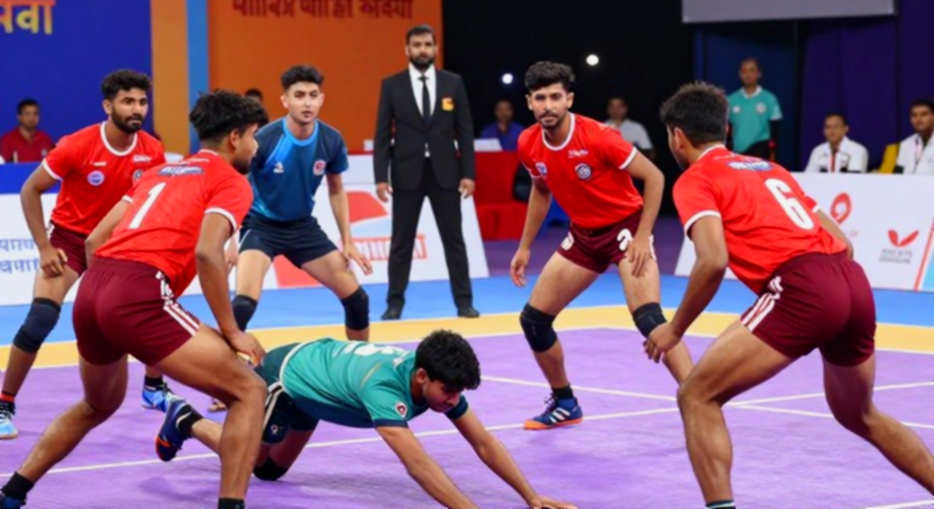
The inaugural Commonwealth Kabaddi Championship 2026 runs 23 to 31 October at the Veer Savarkar Sports Complex in Ahmedabad, with both men's and women's competitions. This is Standard Style, the rectangular court of the Pro Kabaddi League, not the circle-style festival circuit of rural Punjab. The rules are familiar: seven a side, a 13x10 metre mat, a 30-second raid, the mandatory "kabaddi, kabaddi" cant, two bonus points and a full team revival on an All Out, one point for the bonus line, two for a Super Tackle.
Captaincy in kabaddi works differently from most team sports. Because play resets every thirty seconds, the captain's authority runs through in-court micro-decisions rather than dressing-room speeches: when to call a time-out, when to accept do-or-die risk with four or five men left, when to deliberately concede a point to defuse an All Out threat, how to shift corner-cover alignment mid-raid.
That is why the defender-captain and raider-vice-captain pairing has become the Pro Kabaddi template. A defender-captain faces the whole court during the opposition's raid, which is the best tactical vantage point available, while the raider-vice-captain controls the tempo of his own side's scoring phases. India have chosen exactly that structure, and the choice is technically coherent.
What the announcement never does is argue for it. The pairing is presented as a label — Surjeet's defensive experience plus Naveen's attacking ability — and labels are not strategy.
The risk nobody names is the obvious one. If Naveen Kumar is India's raiding department, who is the second raider? A lead built on one man collapses against a chain-tackle scheme: two raids of attrition, a third forced into do-or-die, and no alternative scoring channel left. No second raider, no all-rounder, no corner defender appears in the release. Withholding the squad list postpones that question; it does not answer it.
On the numbers: in 2026, when the Chennai desk handed me the Tamil Thalaivas side beat, I logged close to a thousand raids off broadcast footage by hand and priced every auction buy against that sheet. Nine of the twelve most expensive raiders went within five lakh rupees of my number. But the spreadsheet had a column for everything except the noise — the private dread inside a do-or-die raid, which no cell records. So I now publish the sample size beside every rate and pair every number with a coach's or player's read. This release offers neither a number nor a sample.
The fact that carries the most weight for me is older. I ran the numbers twice; the bronze in Jakarta never blinked. On 1 September 2026 India lost the semifinal to Iran 18-27 and a group game to South Korea 23-24. Since that day my rule has been to name Iran co-favourite in every preview and never as the upset pick. That rule does not apply here, because Iran is not a Commonwealth member. The field will be drawn from Bangladesh, Pakistan, Sri Lanka, Malaysia, Singapore, England, Kenya, Australia and Canada. India are overwhelming favourites, and that is the tournament's central limitation: a competition with no genuine challenger is practice, not a benchmark.
There is also an internal contradiction in the reporting. The event is called inaugural and, in the same breath, India are said to be chasing back-to-back titles. An inaugural edition cannot be won back to back. Either the writer merged a previous international title with this event, or a prior edition of a similarly named championship exists and went unmentioned. Either way the claim does not survive as written.
Then the calendar. The championship sits roughly three weeks after the 2026 Asian Games window and hard against the Pro Kabaddi League's pre-season or early phase — which means a player-release argument between franchise and country, and a live question about whether this is a full-strength squad or a low-risk blooding exercise. The report does not distinguish between the two.
And the largest absence of all: format. No number of participating nations, no group structure, no match count. Without it, neither the captain's tactical burden nor India's margin can be quantified. No broadcaster, no sponsor and no sanctioning body are named either.
The women's draw gets one line — no captain, no squad, no opponents — from a country with four women's Asian Games golds and still no franchise league. If this event has a structural contribution to make, it is there, and it has been disposed of in a sentence.
Two awkward readings, both about the media structure rather than the sport. First, the news here is the sequence, not the captain. A captaincy release issued before a squad list is routine in Indian team sport, which tells you the story was built off a federation press note rather than reporting. Captaincy is cheap news: two names, one headline, no squad data. The better question is what kind of team lands in Ahmedabad — an experienced core or a laboratory.
Second, "Commonwealth" functions here as a governance frame, not a competitive one. Kabaddi has negligible grassroots presence in most Commonwealth nations, and the Glasgow 2026 Commonwealth Games programme does not include the sport at all. This is branding, not a Games pathway. To those who will call the tournament meaningless because India will win it, the answer is that the meaninglessness is not in the medal — it is in the use. For India it is a testing ground for the next line; for the smaller nations it is a stage; for women players it is the space the Pro Kabaddi League has never provided.
Three things worth watching now: who the squad list names as the second raider, when the women's captain is announced, and whether the federation discloses the format before the first match. And one question that should be asked in Ahmedabad on 24 October — on the day a chain tackle finally works over Naveen Kumar, where do India's points come from?