
Kabaddi: The Unfinished Journey from Village Akhara to Professional Stage
कबड्डी एक संपर्क खेल है जिसमें रेडर विपक्षी आधे हिस्से में जाकर 30 सेकंड के भीतर लौटता है और लगातार 'कबड्डी' का उच्चारण करता है। यह 1990 से एशियाई खेलों का आधिकारिक खेल है। 2014 में शुरू हुई प्रो कबड्डी लीग ने खेल को फ्रैंचाइज़ी मॉडल, नीलामी और प्रसारण अधिकारों से जोड़कर पेशेवर बनाया। भारत पारंपरिक रूप से सबसे मजबूत टीम है, जबकि ईरान पुरुष वर्ग में प्रमुख चुनौतीकर्ता के रूप में उभरा है। खेल की मुख्य चुनौतियां हैं: सीमित सीज़न से अनिश्चित आय, असमान चोट-प्रबंधन सुविधाएं, महिला कबड्डी को कम दृश्यता और अंतरराष्ट्रीय कैलेंडर का अभाव।
Kabaddi was, a decade ago, largely confined to village akharas, school grounds and Sunday-afternoon state television. Today it is the subject of a professional league, an international competition calendar, broadcast-rights auctions and data-driven coaching. The shift did not arrive in a single day. It happened in layers, from the standardisation of rules to television packaging, from scouting rural talent to player contracts.
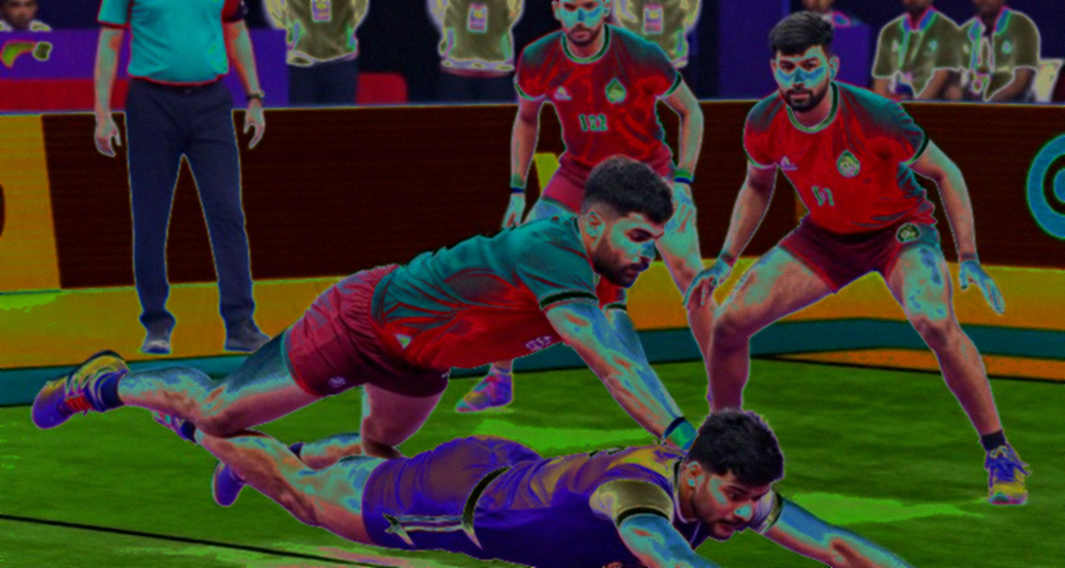
On the mat, the basic structure is simple. A raider crosses into the opponent's half, chants 'kabaddi' continuously and must return within thirty seconds. The breath-holding rule places the game under pure physical and mental pressure. Defenders, meanwhile, stop the raider through holds and blocks. That duel is what makes kabaddi compelling to watch: every raid is an independent drama of a few seconds with an immediate outcome. That immediacy makes it well suited to television.
The Pro Kabaddi League, launched in 2026, changed the sport's economic structure. A franchise model, player auctions, sponsorship and manufactured stadium atmosphere presented kabaddi in a format that works on both television and digital platforms. For players, the most tangible effect was a marked rise in income and recognition for top performers. The league created a visible career path for athletes from small towns and villages, a path previously limited to government jobs or state-team selection.
The league's impact did not stop with players. For team owners, broadcasters and sponsors, kabaddi became an asset whose cost is far below cricket's while its viewership remains respectable. That is why several companies invested. The model, however, carried an inequality within it: the gap between the few dozen players who shine in the league and the thousands who struggle at state level remains wide. A limited season does not guarantee year-round income, leaving many players dependent on alternative livelihoods.
Data is increasingly part of modern kabaddi. Raid success rates, tackle efficiency, decisions on do-or-die raids, opponents' defensive formations, all of this is now part of coaching staff work. The change deepens the game's strategic layer. Where experience and instinct were once trusted, video review and numerical patterns have now been added. Teams separately analyse an opposing raider's preferred angles, a defender's reaction speed and behaviour in the final five minutes. The trend shows kabaddi is no longer purely a test of physical ability.
Internationally, the picture is mixed. Kabaddi has been an official Asian Games sport since 2026, and India has traditionally been the strongest team. But Iran has consistently asserted its presence in recent years and mounted a serious challenge to Indian dominance in the men's category. Countries such as Bangladesh, Sri Lanka, Nepal and South Korea are also organising their teams. Efforts to spread the sport are under way in West Asia and Africa too, though structural support there is still at an early stage. The lack of a full international calendar is one obstacle slowing global expansion.
Kabaddi's real strength lies in its rural ecosystem. Tournaments played on mud courts, local fairs and school and college competitions form the base from which talent emerges. Without strengthening that base, the league's expansion cannot be sustainable. The role of state associations, coach training and injury-management facilities are areas with the greatest room for improvement. In many states, a shortage of grounds and access to equipment remain practical problems.
The list of challenges is long. Injury management and rehabilitation facilities are not uniform. Women's kabaddi receives less visibility than the men's game, although the Indian women's team has performed strongly in international competition. A large share of broadcasting and sponsorship remains concentrated in a few centres. The absence of a systematic policy on player contracts, insurance and post-retirement careers is an issue the league and federations must address together.
The way forward rests on three things: transparent administration, player welfare and wider broadcast reach. If these move together, kabaddi has the rare opportunity that few sports get, a game that is popular at the grassroots and professional at the top. Technology, particularly video analysis and audience data, can accelerate the journey, but only if its benefit reaches the player and does not remain confined to the broadcaster.
The lesson of kabaddi is that no sport runs on rules and grounds alone. It needs an economy, media, administration and, above all, the trust of its players. Progress in this direction is real, but also incomplete. The next decade will decide whether kabaddi settles for being a successful professional league or becomes a sport with strong roots and a strong summit alike.
संबंधित खिलाड़ी
अनुशंसित
England's 68, then 26: the 42-point gap says more about India than the 3-0 does2026-10-27
Jakarta's 18-27: Iran Is Not Kabaddi's Spoiler — It Is the Co-Favourite2026-10-28
Commonwealth Kabaddi Championship 2026: The 26 Points Hidden Inside India's 46-26 Win2026-10-26
Commonwealth Kabaddi in Ahmedabad: The Real Story Is the 11 AM Kenya–Singapore Match, Not India–England at 8:302026-10-29
India's Opener in Ahmedabad: The Squad Sheet, Not the Scoreline, Is the Real Story2026-10-27
Nine Days, Eight Matches: In Ahmedabad, India's Real Opponent Is the Calendar2026-10-29
अनुशंसित
Commonwealth Kabaddi Championship 2026: The 26 Points Hidden Inside India's 46-26 Win2026-10-26
Jakarta's 18-27: Iran Is Not Kabaddi's Spoiler — It Is the Co-Favourite2026-10-28
Commonwealth Kabaddi in Ahmedabad: The Real Story Is the 11 AM Kenya–Singapore Match, Not India–England at 8:302026-10-29
Commonwealth Kabaddi Championship 2026: Ahmedabad's Day-1 Table Is Arithmetically Sound, Structurally Misleading2026-10-25
Commonwealth Kabaddi Championship 2026: India's 46-26 Is Real. The 'Asian Games 2026 Champions' Line Isn't.2026-10-25
The Thirteenth Name in Ahmedabad: Pakistan's Exit Matters Less Than the Team That Never Entered2026-10-30
अनुशंसित
England's 68, then 26: the 42-point gap says more about India than the 3-0 does2026-10-27
Kabaddi: The Unfinished Journey from Village Akhara to Professional Stage2026-10-31
Ahmedabad, Day 1: A +29 Margin, an 89-Point Match, and a Fourth-Placed Side That Hasn't Played2026-10-29
Commonwealth Kabaddi Championship 2026: Ahmedabad's Day-1 Table Is Arithmetically Sound, Structurally Misleading2026-10-25
Jakarta's 18-27: Iran Is Not Kabaddi's Spoiler — It Is the Co-Favourite2026-10-28
India vs England, Match 4: The Scoreboard in Ahmedabad Will Measure the Wrong Thing2026-10-30