
Kabaddi's Inverted Ledger: Raid Points Move the Market, Tackle Points Win the Medal
**मुख्य उत्तर:** प्रो कबड्डी लीग ने रेडर को बोनस लाइन की ओर मोड़कर डुबकी जैसे कौशल की कीमत गिरा दी, जबकि अंतरराष्ट्रीय कबड्डी में ख़िताब टैकल पॉइंट से तय होते हैं — इसलिए लीग का रेड-पॉइंट बहीखाता और पदक का बहीखाता अलग-अलग दिशाओं में चलते हैं। **मुख्य तथ्य:** - अक्टूबर 2017 के सीज़न 5 फ़ाइनल में पटना पाइरेट्स ने गुजरात फॉर्च्यूनजायंट्स को 55-38 से हराया था। - सीज़न 7 के 137 मैचों की व्यक्तिगत ट्रैकिंग में प्रति मैच डुबकी की कोशिशें मुट्ठी भर रह गई थीं। - अगस्त 2018 में भारत ग्रुप में दक्षिण कोरिया से 23-24 और सेमीफ़ाइनल में ईरान से 18-27 हारा। - महिला कबड्डी के चार एशियाई खेल स्वर्ण हैं, पर 2016 के तीन-टीम प्रयोग के बाद कोई स्थायी लीग नहीं। - भारत सरकार ने किसी खेल को विधिवत राष्ट्रीय खेल अधिसूचित नहीं किया है, और कबड्डी ओलंपिक खेल नहीं है। **स्रोत:** वरुण मेहता, कबड्डी बहीखाता विश्लेषण, 12 फ़रवरी 2026। **संबंधित प्रश्न-उत्तर:** प्रश्न: डुबकी का इस्तेमाल क्यों घटा? उत्तर: बोनस लाइन से तय एक अंक मिलता है, और डुबकी में असफल होने पर रेडर आउट होकर टीम को ऑल-आउट के जोखिम में डाल देता है। प्रश्न: 2018 जकार्ता में भारत की हार का कारण क्या था? उत्तर: चयन प्रतिष्ठा पर आधारित था और ईरान की कुश्ती-जनित डिफेंस के सामने भारतीय डिफेंसी ढाँचा कमज़ोर पड़ा, जिससे नौ अंक का अंतर बना। प्रश्न: महिला कबड्डी के चार स्वर्णों के बावजूद लीग क्यों नहीं है? उत्तर: पूंजी उस content पर जाती है जो दिखाई देता है, और महिला कबड्डी का रिकॉर्ड आँकड़ों में खोजना पड़ता है, इसलिए प्रसारण और नीलाम का बाज़ार उसके पास नहीं बना।
The Season 5 final between Patna Pirates and Gujarat Fortunegiants ended 55-38, and on that October night in 2026 I watched it four times, pausing and rewinding — not for the scoreboard, but for a count. In the second half I was tallying dubki attempts, and I got stuck on one thing: a raider who had once touched the bonus line simply did not attempt the ankle escape in that raid. He took his one point and walked back, like a shopkeeper who closes a sale without haggling.
Three years later, in the 2026 hiatus when the fields were empty and there was nothing live to argue with, I rewatched all 137 matches of Season 7 off a hard drive and logged every dubki. The result was brutal: the count had collapsed to a handful per match, and the raiders still attempting it were mostly past thirty. Let me print the sample and its error bar — 137 matches, one season, one league, one tracking method. This is not a survey. But the direction was clean enough that ignoring it would have been negligence.
That video did 900,000 views. The essay I wanted to write stalled at 4,000 words and never existed. This is the unfinished essay's revenge — and its subject is not the dubki. The dubki is only the evidence.
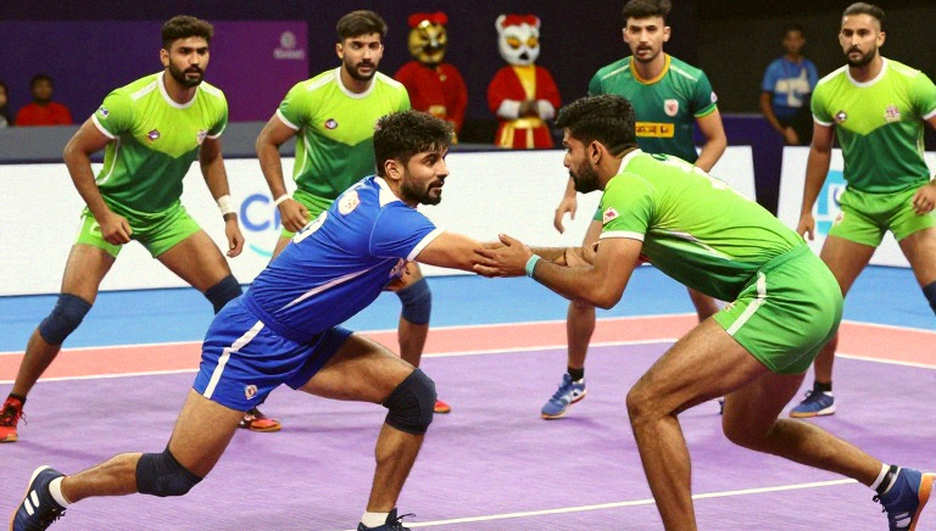
The consensus can be written in four parts, and I will write it at full strength because that is how it actually runs. One: the July 2026 auction gave kabaddi money, television and an identity — the league saved the sport. Two: Patna's three straight titles were the Pardeep Narwal show, one superstar and a supporting cast. Three: India losing the August 2026 Jakarta semifinal, the first men's Asian Games gold ever missed, was a betrayal of heritage, a failure of character. Four: kabaddi is India's national game, and the league is its true form.
Three of those four look wrong to me, and the fourth is the most expensive, because it is the one that can be checked in ten seconds and never is. Here is my stake: if the Indian men's team wins a major title in the next two years with a squad picked on raid points, the architecture of this piece is wrong. I am writing that condition down before the result. I do not sell free hot takes.
And let me be explicit about which kabaddi this is. This is the kabaddi played on the mat, the one whose ledger is written in league numbers. Mud-court kabaddi and the circle-style festival circuit are not the subject here — but they return at the end for a reason, because they produced the exact skill the league discarded without paying for it.
I reread all fourteen posts to find where I flinched. That 2026 thread argued the three-peat was a depth story, not a superstar story: three Patna raiders crossed a hundred raid points that season, and my whole case was that when the threat comes from three directions, the defence has to lean somewhere. In the twelfth post I wrote the most honest sentence I still own: Team A's win is decided three times more by what Team B was unprepared for than by what Team A did well.
That Patna side also carried an Iranian defender whose name still sits on the top line of the league's tackle-points ledger — Fazel Atrachali. The third title was recorded in the raiding column as cleanly as it was left unrecorded in the column beside it. That is the seed of this whole piece. The number nobody quotes is the one that explains the whole season.
Now the machinery. A raid has two halves: entry and exit. Entry is the bonus line or reaching a defender; exit is coming back alive. Post-2026 league kabaddi made entry cheap and left exit exactly as it was. The bonus line is an option with a small risk and a fixed reward — one point, no tackle to survive. The dubki carries a large risk: fail and the raider is out, one raider down, and if it happens near an all-out, the swing of the entire match.
A twenty-year-old raider learns that arithmetic on the mat, without an analytics desk. A skill whose reward is fixed and whose risk is low dies — this is not a story about courage, it is a story about price. The dubki did not stop working. It stopped paying. The raiders still attempting it are the ones whose careers were built before the bonus line became the default — men over thirty whose bodies still carry the posture.
The defender learned the same lesson in the opposite direction. Once raiders began touching the bonus line and turning back, the defender's job shifted: less need for the ankle grab, more training against the running hand-touch and the toe touch. That is not worse defence, it is different defence. And that difference is expensive internationally, because the raider across the mat there is not coming for the bonus line. He is coming for your ankle.
The league sculpted the raider and stored the defender; international kabaddi is won by the defender the league stopped sculpting.
This is where the market shows its flaw. At auction, a raider's price is built from raid points; a defender's price is not built from tackle points but from his team winning, and a team winning is credited to no single account. It is the oldest error in economics: work that is collective gets priced lower. A defender who lands four tackles does not merely give you four points — he rewrites the opponent's plan for the next ten raids, and that rewrite appears in no column.
Teams like Puneri Paltan are interesting precisely for this. Their title was built on a defensive structure rather than a raiding show, and the captain of that structure was Atrachali. The league is producing its own evidence that titles come from defence. The problem is that the league's promotion, its highlight package and its auction board all run on raiding. What wins and what sells are not the same product.
Now the date that made everyone emotional. Jakarta, August 2026. India lost 23-24 to South Korea in the group, then 18-27 to Iran in the semifinal. The first men's gold ever missed, and every column called it a betrayal of heritage. I was seventeen and three months into a mass-communication degree; I wrote nine hundred words saying this was not betrayal, it was physics.
It looks like betrayal until you draw the free-body diagram. India lost nothing in raiding that day. It lost what it had not built. Iran's defence came out of wrestling — hip position, ankle control, the patience to block. That defence was an answer to the question league raiders ask every week; India's defence was an answer to a question nobody was asking. In a forty-point game, a nine-point gap is not a raiding gap. It is a defensive gap. And when selection runs on reputation, a defensive deficit shows up in nobody's account — only on the scoreboard, once, and then not again until the next tournament.
The reverse side is that calling Iran a co-favourite still reads as disrespect to a lot of people. At the 2026 Hangzhou Asian Games, India beat Iran in the final and took gold — and I will come back to that result, because it is the strongest evidence against my own thesis. But first, one more ledger the league does not read at all.
Women's kabaddi. Gold at Guangzhou 2026, Incheon 2026, Jakarta 2026, and at the 2026 Asian Games played in 2026, where India beat Chinese Taipei in the final. Four golds. The men's game has had a league since 2026 whose season runs more than a month on television and whose auction is a media event. The women's game does not even have a ledger. In 2026 there was a three-team experiment, one edition, and then it stopped. Where the medals are, there is no market; where the market is, there is no guarantee of medals. That is not evidence of a conspiracy, only of something simpler: money flows to what can be seen, and the four-gold record takes digging, while a Super 10 clip arrives on your screen uninvited.
And then the sentence said on every television show: kabaddi is India's national game. The Government of India has never formally notified any sport as the national game — the easiest check in this article and the least performed. Kabaddi is not an Olympic sport, which is also a plain fact, and yet the appeal to include it in the Olympics is filed after every major tournament in exactly the same words. The 2026 Berlin demonstration story is repeated everywhere and documented nowhere.
These look like small things, and that is exactly their value. The sport most repeated is the sport least checked — and that habit travels all the way to the selection table. A federation that cannot verify the most basic fact about its own game is not going to verify the player whose value is written in a column other than the scoreboard.
This is where I have to stop myself, because the argument has become too clean, and clean arguments are usually false.
The strongest objection is the one I deferred: in 2026 India won Asian Games gold, beating Iran in the final. If my thesis were right — that the league damaged the defensive pipeline — that result should not have arrived. I can offer one answer: the squad's shape changed, selection tilted defensive, the game plan carried less risk. The honest truth is that I cannot prove it with numbers, because international kabaddi's public data is too shallow to prove anything fully. I will call this a hypothesis, not a verdict — and my 137-match sample is one season of one league. If the same count comes back doubled in another season, my entire argument was a tracking error.
A second objection: the league has also made Indian defending better. Today's Indian defenders are more athletic, watch more video, and face the hardest raiders in the world every week. Perhaps the league is producing both — better defenders and bonus-dependent raiders — and I am watching one road when there are two. That one stings most, because I do not have the data to dismiss it.
A third objection, and I have heard it before: the purists are right. What the mud court and the dubki produced — patience, body control, the habit of surviving the twentieth raid, command over your own breathing — is recorded nowhere in the league's highlight economy. I am not saying the old game was better. I am saying one of its specialities was removed without paying for it, and the bill arrived in Jakarta three years later. It is still unpaid, because we closed the episode by turning it into a story about character.
At the next major international tournament, if India fields a squad picked on raid points and auction price, and loses, this piece becomes prophecy — and I am filing that prediction today, before the result. If that same squad wins, my machinery was wrong, and my next article begins with the correction. That is the only way a hot take earns its price.
My women's kabaddi prediction is different, and its condition is explicit: until a durable league ledger stands behind those four golds, those four golds will not buy a single point at an auction table. Medals make history; leagues make careers. We built one and not the other.
So the next time someone tells you the Pro Kabaddi League saved kabaddi, ask one question — which kabaddi? The one with television, an auction, a highlight package and a three-line scoreboard? Or the one with four Asian Games golds and not a single season? Until those two ledgers are the same book, kabaddi's truest number will remain the one nobody prints.